
“Wait for the Lord; be strong and take heart and wait for the Lord.” (Psalm 27:14)
In December 2019, a magnitude 6.8 earthquake struck the province of Davao del Sur on the island of Mindanao in the Philippines. The damage was widespread—207 of the province’s 232 barangays (villages) were affected. Beyond collapsed structures, the earthquake destabilized hillsides, creating an ongoing risk of landslides. Families were evacuated to safer ground, often leaving behind their homes, possessions, and farms—their primary source of income.
World Renew committed to respond, with plans to deploy a team by March 2020. However, global travel restrictions related to COVID‑19 delayed the response. During this prolonged uncertainty, World Renew’s International Project Manager, Jeff Cosico, wrestled with the waiting. The needs were clear, yet the timing was out of human hands. Finally, when restrictions eased in October 2020, he rallied a team and travelled to Davao del Sur.
Witnessing Prolonged Displacement
When Jeff and his team arrived, the scale of suffering was overwhelming. Families were still living in worn tents and congested evacuation centres nearly a year after the earthquake.
“…we saw families still living in worn tents and congested evacuation centres. I felt the hot temperature…if I was struggling after just a few minutes inside their tents, I can’t imagine how these families lived there for almost a year.”
The heat was not the only concern. Crowded shelters made it nearly impossible to keep safe physical distance, putting already vulnerable families at greater risk as COVID‑19 continued to spread.
The pandemic had also shifted local government priorities and resources. Relief efforts for displaced families were strained as attention turned to immediate public health needs. Village leader Cesario Banan Sr. described the situation in Barangay Tagaytay:
“More than 400 households…had been living in tents. We were holding on to God’s promises that one day our lives would be better. We understood why we were not receiving rations from the government—the pandemic put local government finances under strain.”
“God’s Perfect Time”
For 723 households—over 2,700 people—in five villages across the municipalities of Magsaysay and Bansalan, World Renew’s arrival came at a critical moment.
“Families had been crying out to God because they had no source of income and there were many emerging needs every day,” Cesario shared. “World Renew came to our community in God’s perfect time.”
The response focused on helping the most vulnerable families meet their immediate survival needs while rebuilding toward recovery and long-term resilience. Priority was given to households with members who had disabilities, senior citizens, very young children, single parents, and child-headed households.
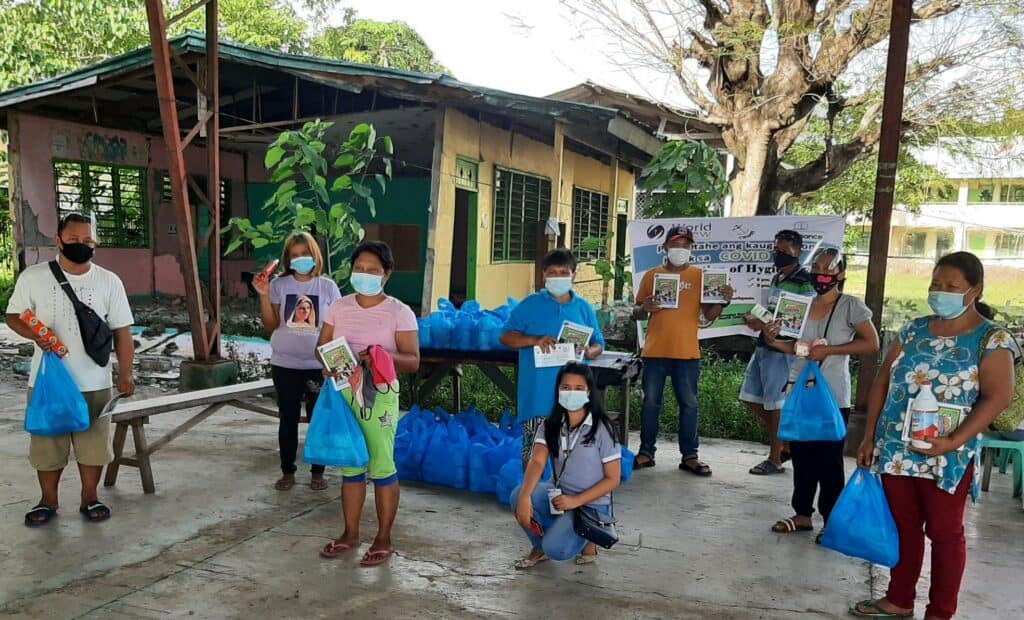
Families received COVID‑19 awareness materials and hygiene kits that included soap, toothpaste, laundry soap, liquid disinfectant, reusable masks, and face shields—simple items that restored dignity and reduced health risks.
Restoring Livelihoods and Hope
Recovery went beyond emergency relief. Families participated in training in animal husbandry and vegetable farming, followed by the distribution of livestock such as goats, piglets, rabbits, and native chickens, along with seeds and farm tools. Four horses were provided to help transport people and farm goods to market, and two carabao—a water buffalo native to the Philippines—supported ploughing and other farm work.
Small business owners also received training in business and financial management. Food vendors, fish sellers, vegetable resellers, sari‑sari store owners, and other micro‑entrepreneurs were able to restart and strengthen their livelihoods. In total, 526 families regained the ability to earn an income.
To help families meet immediate needs while livelihoods were being rebuilt, 681 participants took part in a cash‑for‑work program. Jeff reflected:
“Ninety‑six percent of the families used their money to buy rice. When asked why, they said they had been eating root crops for months and rarely had rice on the table.”
Others used the income for medicine, hygiene supplies, vitamins, kitchenware, farm tools, and other essentials.
The program also strengthened community infrastructure. Participants cleared 7.2 kilometres of roads, dredged 16.5 kilometres of canals, and laid three kilometres of water pipes. Cesario described the lasting impact:
“Roads are now cleared and accessible, allowing us to bring our products to market. Flooding no longer settles during heavy rain. Clean water now reaches the evacuation camp, improving daily life—especially for women and children who no longer need to walk kilometres to wash and bathe.”
After nearly five and a half months in the region, the team prepared to return home. One grateful farmer summed up the partnership simply:
“…after you leave, we will continue what you have started.”
