
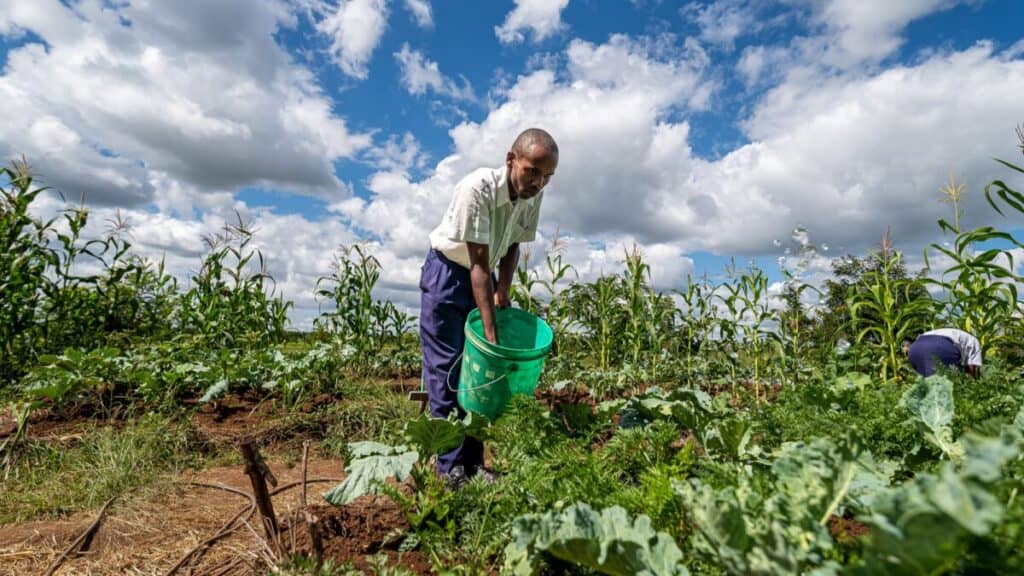
The weather was unpredictable. Too much rain. Then too little. Lydia Waweru was frustrated by her harvests. Her area was receiving little rainfall, and the sandy soil couldn’t retain enough moisture. Her crop yields were declining over time, resulting in steadily reduced income from her farm.
The extremes of climate change and erratic weather are having an outsized impact on small-scale agricultural production around the world (IPCC, FAO). In parts of Africa, the situation is becoming dire.
According to Stephan Lutz, a Program Consultant with World Renew, small-scale farmers in Kenya are losing hope:
“You can imagine the stress when you plant your seeds and you want to grow something, and then the rains don’t come. For the first season, you might have some stored food or some cash, maybe some animals to help get you by. But when the rain doesn’t come the next season and the next? Every time the rain doesn’t come, it adds stress to people’s lives and makes it harder for them to recover.”
The worst impacts of climate change are often felt most severely by vulnerable communities. For these families, there is little margin for loss and few resources available to invest in adaptation. As one agronomist noted:
“In one of the communities we visited, only five percent of households have enough food year-round. That means 95 percent of households go hungry for at least one part of the year. And often that hungry period often coincides with the main growing season. How do you work efficiently on an empty stomach?”
Climate-Resilient Farming in Kenya Creates New Opportunities
Farmers must adapt to survive. That’s where World Renew’s sustainable agriculture training comes in.
Recognizing the realities of changing weather patterns, sustainable agriculture offers a different approach. Farmers learn to minimize tillage, maximize soil cover, diversify crops, and use natural methods to manage pests. This training is being implemented in dozens of countries around the world, and World Renew staff have seen repeatedly how adopting sustainable practices can increase crop yields, even during periods of limited rainfall.
Jenninah Kabiswa, World Renew’s Country Director in Kenya, is closely involved in agriculture training initiatives. She believes this type of education is especially important in Kenya, where agriculture plays a vital role in people’s livelihoods. During a Facebook Live interview, she noted:
“It’s very important that we work to ensure that farmers get as much yield as possible from their land. [This training] is really useful for communities that are dry or semi-dry, and where the rain patterns are unpredictable.”
Kabiswa has witnessed remarkable results when farmers fully apply sustainable agriculture principles. Crops are often higher quality, helping farmers earn better prices at local markets.
“We have seen a farm’s yield go from just 2-3 bags of maize to 10 bags of maize!”
This increase in production and income also creates opportunities for growth.
“The farmers are excited and are able to begin expanding their farms from around ¼ acre to 1 acre,” she shares.
Sustainable Agriculture Helps Farmers Adapt to Climate Change
Implementing sustainable agriculture requires behavioural change from farmers who have long relied on traditional methods. Lutz explains:
“We work with ‘champion farmers’ in Kenya, [people] who have adopted [sustainable] agriculture, and then they will reach out to 2-3 other farmers.”
World Renew staff encourage farmers to experiment with different techniques and evaluate the results for themselves.
Lydia participated in agricultural training and began changing her methods. The first year was not successful, but she continued working with program staff to make adjustments. Lutz explains that Lydia diversified her crops and ensured sufficient mulch and ground cover through organic materials. The improvement in crop yields was dramatic, even during seasons with inadequate rainfall.
For Lydia, sustainable agriculture combined with ongoing mentoring has been life-changing.
“My land is now productive. I am a happy mother who is able to provide for my family with a variety of food, which is healthy and nutritious. I meet my household needs and I am able to serve God and our church with what I have produced from my farm. I have made significant income and with it I have managed to construct a permanent house.’’
Yet, as Kabiswa is quick to point out, meaningful change takes time.
“You must take the long view of this type of work,” she shares. “It doesn’t provide a quick or easy solution. When we come into a community, we of course come with expertise and knowledge. But we also recognize that these communities have things to teach us. And so we come with a desire to learn from them as well. That is our ethos at World Renew…It is a culture of love!”
Growing Stronger Food Security
World Renew’s sustainable agriculture initiatives are part of a broader commitment to strengthening food security around the world.
Through our Food Security programs, World Renew works alongside farming families to improve agricultural production, diversify incomes, increase access to nutritious food, and build resilience to climate-related shocks. By focusing on locally led solutions, communities are better equipped to withstand drought, changing rainfall patterns, and other environmental challenges while creating lasting pathways out of poverty.
Sustainable agriculture plays a critical role in this work. Healthy soils, diversified crops, and climate-adaptive farming practices help families harvest more food and generate more income, even under difficult conditions. Learn more about the principles behind these approaches in our blog, What Is Sustainable Agriculture?, and discover how World Renew is helping communities build stronger, more food-secure futures.
