

Written by Melody Zhang
Originally published by Sojourners (2019) and adapted for the World Renew’s global audience.
This year, the seasonal rains in Kenya came two months late. “Even the weatherman can’t forecast the weather,” Stephen Katama, a local shopkeeper in Nairobi, told me when I traveled to East Africa in June.
“We can’t tell the difference between the summer and winter here anymore.”
Across sub-Saharan Africa, changing weather patterns are making life increasingly unpredictable. Rainfall has become more frequent and intense in some places while droughts persist in others. A single day of heavy rain can bring the amount of precipitation once expected over many months, disrupting livelihoods and threatening food security for farming families in Kenya and Uganda.
As conversations about climate change justice continue around the world, communities in East Africa are already living with the impacts of a changing climate every day.
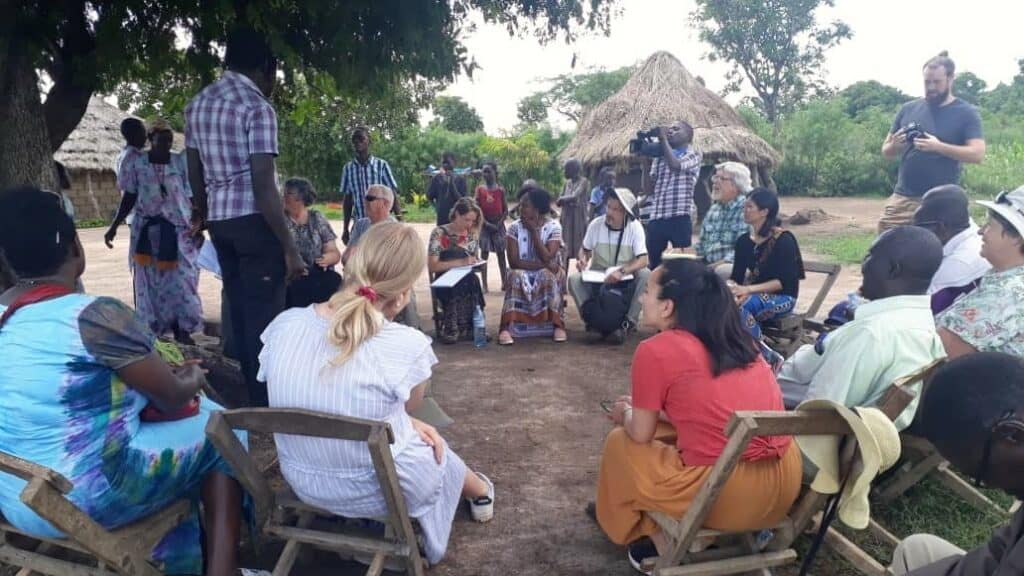
World Renew’s Climate Witness Project and the Christian Reformed Church in North America (CRCNA) brought me to Nakuru, Kenya, and to North Teso and Soroti, Uganda, where I met farming communities experiencing dramatic shifts in weather patterns firsthand. We went to witness climate collapse on the front lines.
Climate Change Justice and Its Human Impact
In North Teso, I met Pentecostal pastor Emmanuel Okwalinga. Drawing from scripture and reflecting on the groaning of creation and God’s people, Okwalinga recalled the devastating drought of the previous year.
Farmers went to bed hungry, stayed awake through the night, and rose weak with hunger to continue cultivating their fields, he said. Chronic cycles of drought and flooding have reduced crop yields and contributed to food insecurity and deepening poverty.
The reality of climate change justice became impossible to ignore. Communities contributing very little to global greenhouse gas emissions are often among those experiencing the most severe consequences.
While some political leaders in the United States continued to question climate science at the time, Kenya and Uganda were pursuing practical climate solutions. More than 40 years ago, Kenyan activist Wangari Maathai founded the Green Belt Movement, helping transform landscapes through strategic tree planting.
Today, faith communities continue that work. The National Council of Churches of Kenya includes climate justice among its strategic priorities, encouraging church greening initiatives and reforestation efforts. Kenya and Uganda have also pursued commitments under the Paris Agreement, while Kenya has become a leader in renewable energy development.
Climate Resilience Rooted in Community
Despite enormous challenges, the communities I visited offered remarkable examples of hope and resilience.
Farmers are implementing conservation agriculture practices such as low tillage, intercropping, and mulching to improve soil health and strengthen crop production. These approaches help families adapt to increasingly unpredictable weather conditions.
In Nakuru, youth groups are creating farm-based microbusinesses that support local economies and encourage agricultural innovation. Women play a particularly important role in small-scale farming throughout Kenya. Strengthening the capacity of women farmers helps entire families and communities become more food secure.
In Kaberamaido, Uganda, churches host village savings and loan associations. Through these groups, community members save money together, earn interest, and provide loans to one another. These local financial networks are especially valuable for farming families facing climate-related uncertainty.
These efforts demonstrate that climate resilience is not just about surviving environmental challenges. It is also about strengthening communities, supporting livelihoods, and creating pathways toward long-term sustainability.
Bearing Witness and Taking Action
The United States has one of the largest per-capita carbon footprints in the world, while Kenya and Uganda together account for only a small fraction of global greenhouse gas emissions.
During my visit, Peter Muthengi, Disaster Risk Reduction Coordinator for Anglican Development Services (ADS), told me he would not choose to be American even if given the opportunity.
He would rather have Africa’s genuine wealth, including its natural resources. He would rather not live in a country that is materially rich yet spiritually and ecologically impoverished.
His comments challenged me to reflect more deeply on power, privilege, and responsibility. I became increasingly aware of the systems and structures that enabled me to travel from one of the world’s wealthiest countries to witness these realities firsthand.
I traveled to Kenya and Uganda to be a Christian witness. Witnessing carries responsibility. When we see something significant, we are called to tell the truth about it.
And this truth is clear: people are suffering now, not someday in the future. Homes and farms are being damaged. Families are experiencing hunger. Communities are facing displacement, conflict, and deep hardship because of climate change impacts.
During a worship service at Christ Church, an Anglican congregation in Nairobi, Rev. Linda Ochola-Adolwa preached that civil society is a contested space, not a neutral one. She challenged us to engage faithfully in the places where we live and serve.
“Are we sufficiently troubled for the ways of our society?” she asked.
Are we sufficiently troubled enough to respond?
The experiences of the most vulnerable people, rather than those with the most privilege or visibility, should inform policies and decisions. Effective responses must be compassionate, transformative, and comprehensive.
After all I have seen and heard, I cannot help but bear witness to these stories, to educate, and to act.
Will you?
Join the Journey Toward Climate Justice
The stories witnessed in Kenya and Uganda remind us that climate change is not a distant threat but a present reality for millions of people around the world. Through World Renew, you can help support food security, strengthen climate resilience, equip farming families, and help communities adapt to changing conditions.
There are many ways to get involved as they work toward a more hopeful and sustainable future.Whether through learning, praying, advocating, volunteering, or giving, each of us has a role to play. Together, we can stand alongside vulnerable communities as they work toward a more hopeful and sustainable future.
Editor’s note: This story was originally published in 2019 and has been updated for World Renew’s global audience and web experience while preserving the original story and perspective.
