
In July 2021, the United Nations reported a dramatic worsening of global hunger in 2020, much of it linked to the fallout from COVID‑19. Measures put in place to slow the spread of the virus disrupted food supply chains and caused food prices to rise sharply, placing added strain on households already living with income instability. Combined with widespread job losses—especially among daily‑wage workers—food security became further out of reach for many of the world’s most vulnerable families.
World Renew Asia Regional Director, Ruairidh Waddell explains, “In places like Bangladesh, India, and Cambodia, the bulk of the people are daily‑wage earners, so they rely on that $1.50 a day; they need that daily income to survive. What we saw with the COVID pandemic was multiple lockdowns, and the inability for people to get that $1.50 a day… With COVID, we’ve seen a backsliding of developmental outcomes… For instance, you see that the Cambodian GDP has fallen from around 24 billion to 17 billion over the last two years. It is a massive contraction within an economy and most of that is around daily‑wage earners.”
Intersecting Challenges: Income, Climate, and Food Security
Beyond the economic impacts of the pandemic, families around the world face an additional and growing challenge: changing weather patterns. Unpredictable rainfall, extended droughts, and extreme weather events make it increasingly difficult for farmers to sustain reliable harvests.
“What I see in Asia is the intersectionality of many different challenges,” Ruairidh says, “the primary ones being the impact that climate change is having on the places where World Renew works and COVID.”
As health crises, economic shocks, and climate pressures converge, the risk of families slipping deeper into food insecurity continues to grow. The question is not only how to respond in crisis, but how to help communities withstand future shocks.
Building Resilience Through Climate‑Adaptive Farming
Over the past decade, World Renew has learned that lasting food security depends on resilience. From training in climate‑adaptive farming practices to teaching improved storage and diversification strategies, World Renew and its partners work alongside communities to build skills and systems that endure beyond any single emergency.
By equipping smallholder farmers with practical tools and knowledge, communities are better positioned to manage uncertainty—whether caused by pandemics, climate events, or economic disruption. One approach that has proven effective is supporting farmers in adopting adaptive, locally appropriate agricultural methods that protect both livelihoods and the land.
A Family’s Journey Toward Stability
For Mr. Snguon Touch, who lives with his wife and five children in Chhuk district, Kampot province, Cambodia, returning to farming—and embracing new techniques—became a pathway to renewed stability during the COVID‑19 pandemic.
Before the pandemic, Mr. Touch relied on traditional farming methods but struggled to earn enough to meet his family’s basic needs. For six years, he worked as a construction labourer in a distant village, sacrificing time with his family in exchange for unreliable income.
When COVID‑19 spread and work opportunities disappeared, Mr. Touch returned home. Like many daily‑wage earners, he found occasional local work insufficient and uncertain. His experience changed when he met Nen Veth, an instructor with an agricultural program for new farmers facilitated by World Renew’s local partner, OREDA.
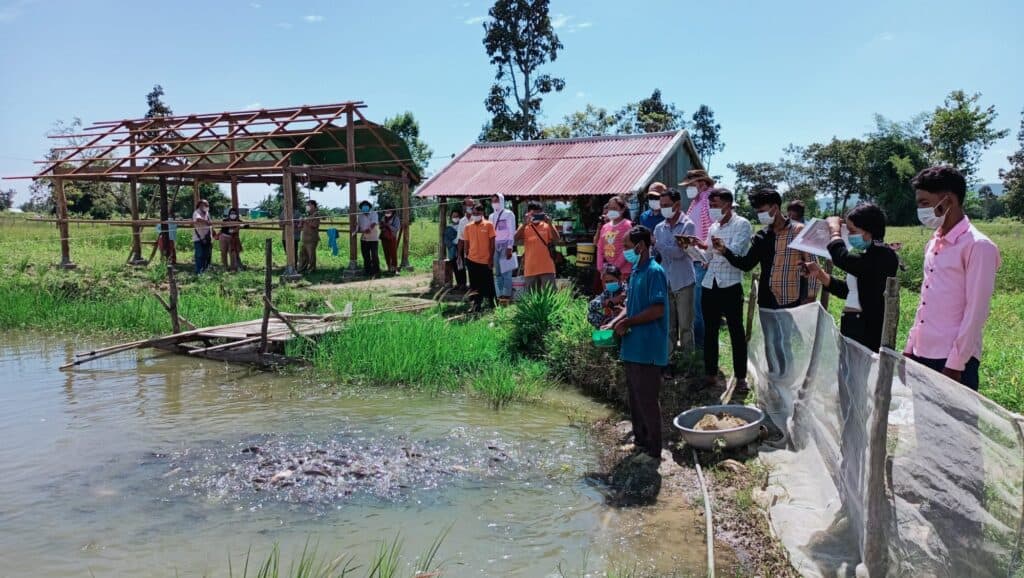
Through the program, Mr. Touch learned new skills and began experimenting with vegetable farming, chicken rearing, and sustainable fish farming. He learned how to produce fish feed using local resources and gradually expanded his operation. Today, Mr. Touch manages three fish ponds, harvesting several species, and earns up to $1,350 USD every three to five months—enough to meet his family’s needs and plan for the future.
Moving Forward Together
Mr. Touch’s story reflects World Renew Asia’s long‑standing commitment to practical, community‑driven solutions that help families journey toward lasting food security. Yet setbacks from recent global crises mean that progress has been lost, and new vulnerabilities have emerged.
To prevent more families from being pushed into food insecurity, support is needed to expand this work and deepen it in the communities where it has already begun. By investing in resilient livelihoods and climate‑adaptive food systems, we can help farming families not only survive future challenges, but face them with hope.
Through your support of World Renew’s food security programs, you help equip families around the world with the training and tools they need to build resilient, sustainable futures—rooted in dignity, opportunity, and hope.
