
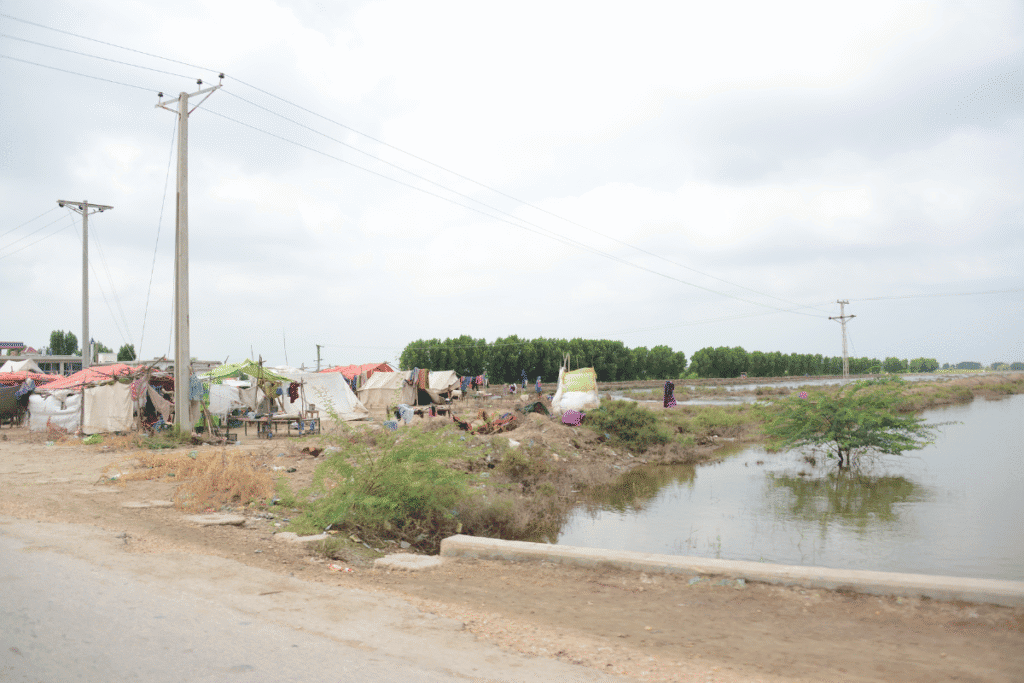
When record monsoon rains overwhelmed rivers and swept across roads, homes, and schools, much of Pakistan was left in a state of emergency. Although World Renew does not have a direct presence in Pakistan, the global Christian community responded with urgency, prayer, and generosity. Through World Renew’s partnership with the Canadian Foodgrains Bank, support was channelled to the on‑ground relief efforts of our peer organization, Presbyterian World Service & Development (PWS&D), working alongside their local partner, Community World Service Asia.
Months after the rains first began, some of the hardest‑hit areas were still underwater. Roads could only be travelled by boat, hampering aid efforts and delaying recovery. Rebuilding would take time—as would healing from the losses endured.
A Home Surrounded by Water
One village deeply impacted by the flooding was once home to more than 2,700 people and over five hundred families. Now, it feels abandoned. Houses sit half‑submerged, giving the village the appearance of a ghost town.
This is where Tejan, an elderly woman, warmly welcomes staff from Community World Service Asia as they step from their boat directly into her home.
Utensils are spread across Tejan’s patio. “We just got done washing all the utensils,” she says, gesturing to the floodwater settled around her house. “We [used] this water. This is the only water we have access to. We use it to wash clothes and to bathe. We try to keep it in the sun so that the dirt settles down first.”
Pointing to a nearby tank, she explains, “We used to have a water reserve but with the rains, it leaked and all the dirty water got mixed into it. So we have no option but to use this. We use it for cooking too.”
A group of women and children—mostly relatives—soon joins Tejan and her guests. The village had been evacuated by the army weeks earlier, but the women stayed behind to protect their home. They also stayed to protect their honour.
Tejan’s family belongs to the conservative Baloch tribe, whose female members do not mingle with men from outside their community. Living in emergency camps or temporary roadside settlements would have exposed them to unfamiliar men, something the women felt they could not risk.
Daily Survival and Quiet Courage
Tejan is a widow and the mother of eleven children, most now married. Two of her sons remain connected to the household. One continues to work at a government office so he can maintain an income. The other, who depended on livestock and a small agrarian garden, has moved with his children into a roadside tent in hopes of receiving in‑kind support from passing government agencies, individuals, or humanitarian organizations.
Tejan’s brother occasionally sends flour, lentils, milk, and water. “The water he sends is treated like holy water,” Tejan laughs. “We use it very sparingly as we know it cannot last all of us very long.” But her humour is edged with concern: “I do not think my brother can keep supporting us. His own house and lands have also been affected.”
Food insecurity is a constant worry. “We mostly eat one meal a day,” Tejan says. “That meal consists of some flour we cook together with chopped onions, chillies, and [the odd time], tomatoes. We cook all of it together because we do not have enough fire-wood or fuel so we cannot waste it on cooking [them] separately.”
There are other fears, too. “Many of us have not stepped out of this house since the floods … We do not let [the children] go out much and have to guard them well as there are many snakes in the water that come to our house too. We have heard that a lot of the children in our village have also gotten sick.”
Holding Onto Hope
Tejan leads her visitors to what was once her backyard garden. Eight to ten feet of water now covers the land where she once grew vegetables. Tears fill her eyes as she looks on.
Her home was her sanctuary—a place of pride and memory. Now, the walls leak, and much of the outer structure is badly damaged. Living conditions are dangerous, yet Tejan remains. She holds onto hope: hope that her prayers will be answered, hope that the waters will recede, and hope that her family’s health and safety—and access to food and clean water—will one day be restored.
Photo provided by Community World Service Asia.
