
The hostilities in Ukraine have delivered daily reminders that the risks conflict creates for human lives go far beyond acts of violence. Conflict also affects people’s ability to access food. In 2018, the United Nations recognized conflict as a key driver of severe food crises, including famine. Since then, global conflicts have continued to displace millions of people, disrupting livelihoods, markets, and food systems. In Ukraine alone, millions have been forced to flee their homes or remain displaced within their own country.
Across the world, these same patterns are repeated in places that receive far less media attention. Where conflict persists, families are often cut off from farmland, employment, and trade, making it increasingly difficult to meet even their most basic food needs.
Displacement and Hunger in the Sahel
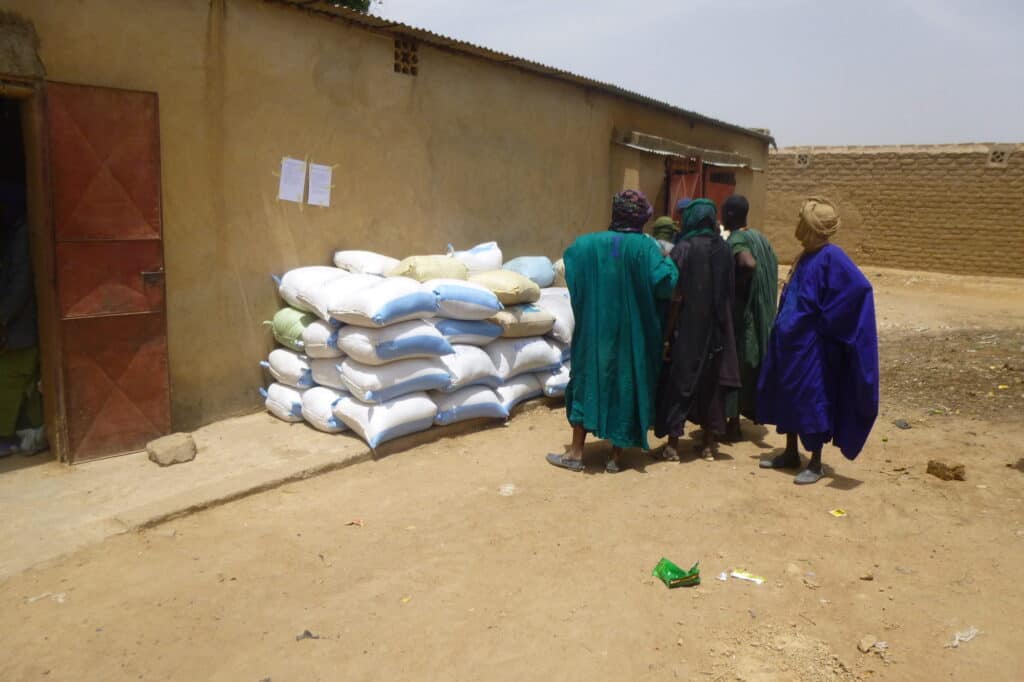
In one country where World Renew works in the Sahel region, ongoing insecurity has forced thousands of people to flee their homes. Camps that provide refuge offer safety, but limited opportunities for families to earn an income or grow food.
Yuusuf*, 56, a father of eight, shared his experience:
“After the arrival of the Jihadists, I left my village.…Currently, I have no fixed activity to feed my family. Before being internally displaced, I was a teacher…but here I have no [students].”
For families like Yuusuf’s, displacement means the loss of dignity and stability, not only shelter. World Renew and its local partners have worked to respond by providing emergency food support to displaced households living in these camps.
Adaeze, 30, a mother of five, explained how this support affected her family:
“I was a beneficiary of the emergency program of World Renew and its partner. [I received] a kit consisting of 100 kg of rice, 40 kg of beans and 5 liters of oil. Before this, my family hardly ate once a day; but with the arrival of this food, my family eats three times a day.”
A Worsening Global Food Crisis
In the Sahel region, changing weather patterns have compounded the effects of conflict. Prolonged drought and repeated failed harvests have further weakened food security. The United Nations has warned that millions of people in the region face acute food insecurity, with families often forced to make impossible choices just to survive.
World Renew’s initial food assistance program in the region was designed to support some of the most vulnerable households for a limited time. However, as conflict and climate pressures continue, the need has not diminished. Many families still wake each day facing hunger and deep uncertainty about the future.
Amara, 20, a mother of three, shared a loss no parent should have to endure:
“Because of the growing insecurity in our region, my husband and I left our village…a few days later, [there was] an accident in which we lost one of our children and a second was seriously injured.”
While a food kit cannot ease Amara’s grief, it can lessen the daily burden of worrying about how to feed her surviving children.
Conflict’s Ripple Effects on Global Food Systems
At the same time, conflict on a global scale continues to reshape food systems. Russia and Ukraine are major producers of wheat, barley, maize, and oil. Disruptions to these supplies have driven food prices sharply upward, placing additional strain on humanitarian responses and on families who were already struggling to afford food. The impact is felt most severely in parts of Africa, Asia, and the Near East, where vulnerable households spend a large share of their income on food.
Martin Griffiths, Under‑Secretary‑General for Humanitarian Affairs and Emergency Relief Coordinator for the Office for the Coordination of Humanitarian Affairs (OCHA), summed up the situation starkly:
“Entire families in the Sahel are on the brink of starvation . . . The recent spike in food prices driven by the conflict between Russia and Ukraine is threatening to turn a food security crisis into a humanitarian disaster. If we don’t act now, people will perish.”
These pressures extend well beyond any one region.
Beyond Borders, Beyond the Headlines
Stories like these highlight how deeply human conflict is intertwined with hunger—and how its consequences ripple far beyond borders. For families already living with displacement, loss, and uncertainty, access to food is not just a matter of survival, but of dignity and hope. Amid ongoing conflict and rising global pressures, World Renew continues to work alongside local partners to support vulnerable communities as they face today’s crises and seek pathways toward a more secure future.
*For security reasons the country cannot be identified and names have been changed to protect identity.
