
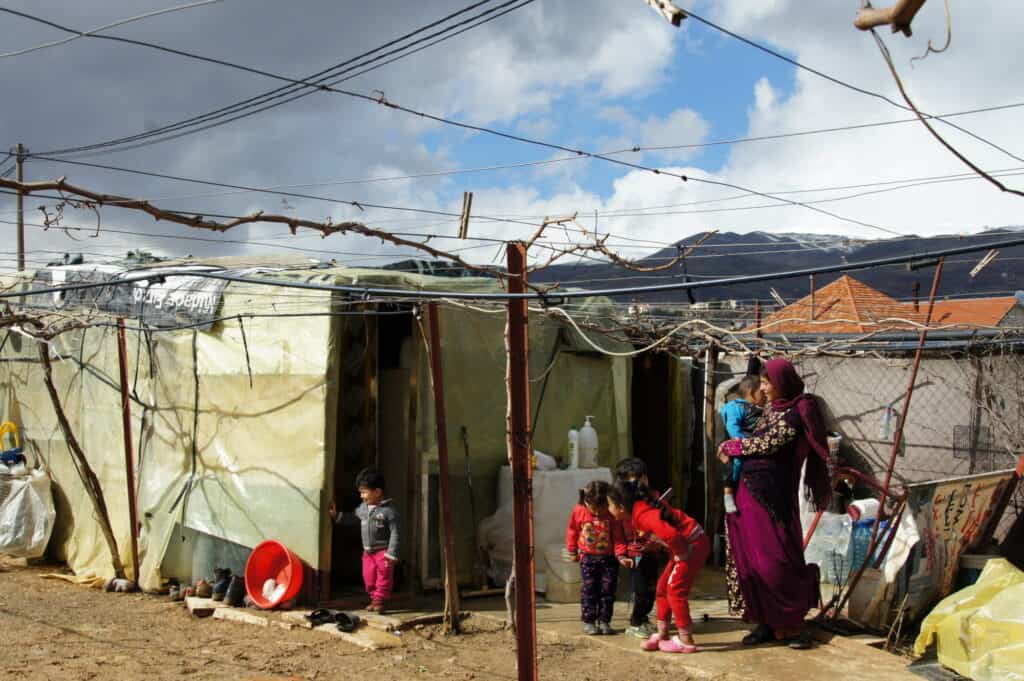
Amid ongoing economic, political, and regional crises, communities across Lebanon continue to face severe pressure on food systems, livelihoods, and social services. World Renew is monitoring these conditions closely alongside local partners.
Nearly one in three people in Lebanon is a refugee, the majority having fled from Syria. Many remain displaced with limited options for return or resettlement. For several years, World Renew has worked through our partner MERATH to support local churches as they respond to the needs of displaced families and host communities. Current conditions, however, are making that response increasingly difficult to sustain.
Compounding pressures on daily life
Lebanon relies heavily on imported grain, including supplies that have been disrupted by international conflict. Food access challenges are compounded by political instability, high inflation, and a prolonged financial crisis that has limited access to personal savings and reduced purchasing power. The ongoing impact of the 2020 Beirut port explosion, which destroyed major grain siloes, continues to affect national food storage capacity.
“It feels like the plagues of Lebanon,” says MERATH communications manager, Sophie Nasrallah. “People don’t know where their next meal is going to come from. It reminds me of God’s people in the wilderness, when they really had to rely on God’s manna every day.”
Access to medicine and fuel remains inconsistent, and rising costs are affecting households across income levels. “Many of our qualified people are leaving because they can’t earn a decent income anymore,” Nasrallah notes. She adds that prolonged uncertainty has taken a toll on communities and service providers alike. “It’s hard to even ask how you’re doing. Everyone is burnt out.”
Impact on partner churches and programming
As financial support for community response has declined, MERATH has been required to make difficult decisions about programme scope and reach. Local churches—many of which had chosen to serve Syrian neighbours despite a complex shared history—are now facing economic strain themselves.
“Funding is decreasing as compared to the previous years, so we are not only making tough decisions about who we can assist, but we are making even tougher decisions about who we will stop helping although everyone still needs it so badly,” says Nasrallah. “Our partner churches have established meaningful relationships with these families. This means we’re scaling down when we should be scaling up.”
Ongoing presence despite constraints
While programme capacity has been reduced, partner churches continue to maintain relationships with vulnerable families and to offer support where possible. MERATH reports that these local networks remain essential to identifying needs, sharing information, and providing accompaniment during a period of sustained crisis.
“Our comfort is believing that God is in control,” Nasrallah reflects. “Even though we might not be able to keep on supporting all families, we trust God will provide. We know that our partner churches will continue to check up on them and help in any way they are able.”
Learn more
World Renew continues to accompany partners responding to complex and protracted crises around the world, including food insecurity, displacement, and economic instability.
To learn more about how we work alongside local churches and organizations during emergencies and long‑term recovery, visit worldrenew.org/international-disaster-response.
You can also explore more partner updates and situational briefings from communities facing ongoing crisis in our News section.
