
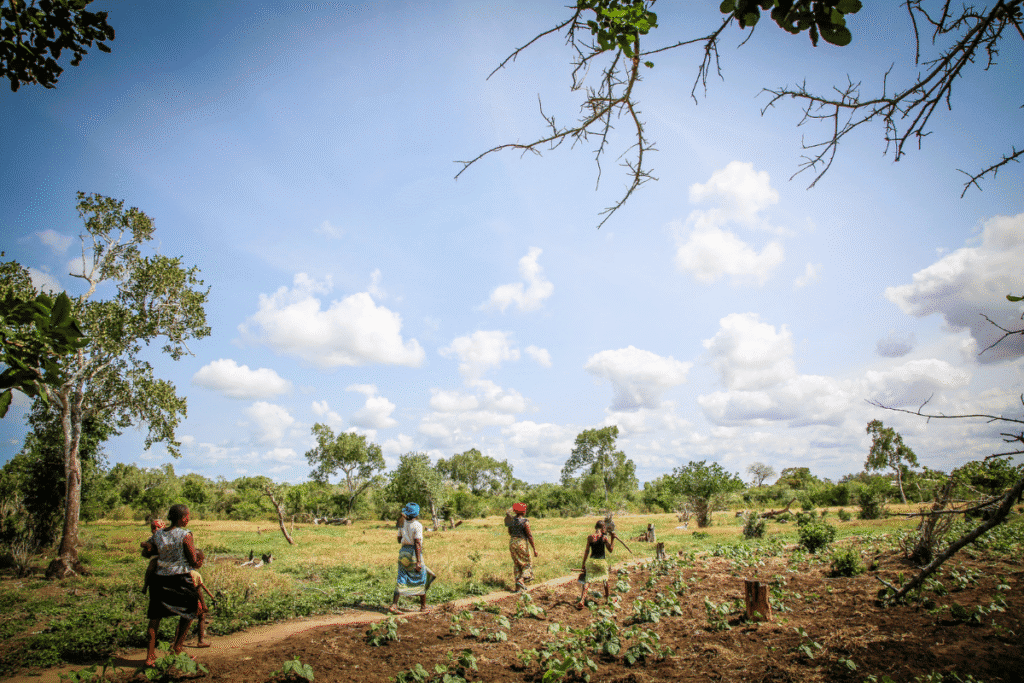
The weather was unpredictable. Too much rain. Then too little.
Lydia Waweru was frustrated by her harvests. Her area was receiving little rainfall, and the sandy soil could not retain enough moisture. Over time, her crop yields declined, and with them the income her family depended on.
Across many regions of the world, the extremes of climate‑change‑driven weather patterns are having an outsized impact on small‑scale farmers. In parts of East Africa, the situation has become especially challenging. According to Stephan Lutz, a Program Consultant with World Renew, many farmers in Kenya are struggling to see a way forward.
“You can imagine the stress when you plant your seeds and you want to grow something, and then the rains don’t come. For the first season, you might have some stored food or some cash, maybe some animals to help get you by. But when the rain doesn’t come the next season and the next? Every time the rain doesn’t come, it adds stress to people’s lives and makes it harder for them to recover.”
Climate Change and Vulnerability
The worst impacts of climate change are often felt by those with the fewest resources to adapt. For many farming families, there is little margin for loss and few opportunities to invest in new approaches that could reduce risk.
As one agronomist observed, “In one of the communities we visited, only five percent of households have enough food year‑round. That means 95 percent of households go hungry for at least one part of the year. And often that hungry period coincides with the main growing season. How do you work efficiently on an empty stomach?”
Farmers are being forced to adapt in order to survive. This is where World Renew’s Conservation Agriculture (CA) training plays a critical role.
Adapting Through Conservation Agriculture
Responding to the realities of unstable weather patterns, conservation agriculture offers a practical, resilient approach. Farmers are trained to minimize tillage, maximize soil cover, and strategically combine crops to improve soil health and reduce pests. Implemented in dozens of countries, the program has consistently shown that applying CA principles can improve yields for small‑scale farmers, even during periods of erratic rainfall.
Jenninah Kabiswa, World Renew’s Country Director in Kenya, has seen the value of this approach firsthand. Agriculture employs nearly a third of Kenya’s population, making resilient farming practices essential.
“It’s very important that we work to ensure that farmers get as much yield as possible from their land,” she explains. “This training is especially useful for communities that are dry or semi‑dry, and where rain patterns are unpredictable.”
When farmers fully apply conservation agriculture principles, the results can be striking. Yields improve, crop quality increases, and farmers are able to secure better prices at market. “We have seen a farm’s yield go from just two or three bags of maize to ten bags of maize,” Kabiswa notes. Increased production can also allow families to expand their operations. “The farmers are excited and are able to begin expanding their farms from about a quarter of an acre to a full acre.”
From Training to Transformation
Adopting conservation agriculture requires a shift from long‑established farming methods. According to Lutz, World Renew works closely with “champion farmers”—those who have embraced CA and can share their experience with others in their communities. Farmers are encouraged to experiment, observe results, and make informed decisions for themselves.
Lydia participated in a conservation agriculture training and began changing her farming practices. The first year brought limited results. With guidance from program staff, however, she adjusted her approach—diversifying her crops and increasing soil cover with organic mulch. Even in seasons with inadequate rainfall, the improvement in yields was dramatic.
For Lydia, conservation agriculture, combined with ongoing mentorship, has been life‑changing.
“My land is now productive. I am a happy mother who is able to provide for my family with a variety of food, which is healthy and nutritious. I meet my household needs and I am able to serve God and our church with what I have produced from my farm. I have made significant income and with it I have managed to construct a permanent house.”
Kabiswa is quick to emphasize that these results take time. “You must take the long view of this type of work,” she says. “It doesn’t provide a quick or easy solution. When we come into a community, we bring expertise and knowledge, but we also recognize that communities have much to teach us. We come with a desire to learn as well. That is our ethos at World Renew… it is a culture of love.”
As climate change continues to reshape growing conditions around the world, approaches like conservation agriculture offer practical hope—helping farmers build resilience, protect their livelihoods, and steward their land for future generations.
