
As extreme and unpredictable weather continues to take a heavy toll on farming families around the world, the need to protect forests and steward the earth’s resources wisely has never been more urgent. In vulnerable communities in India, World Renew’s local partner, EFICOR, is helping families take practical steps to restore and care for their land.
Through Farmer-Managed Natural Regeneration (FMNR) training sessions, participants learn how to care for forests by selectively pruning trees and encouraging natural regrowth. These sessions also highlight how healthy forests can contribute to cleaner air and more stable weather patterns, including more predictable monsoons.
Sundra Pahadia, 45, lives in Sahibganj district with his wife, Mangli Pahadin, 40, and their two teenage children. The family owns a small plot of land that includes a section of forest. Sundra, a farmer and day labourer, had long struggled with people entering his land to cut trees and sell them as firewood at the local market.
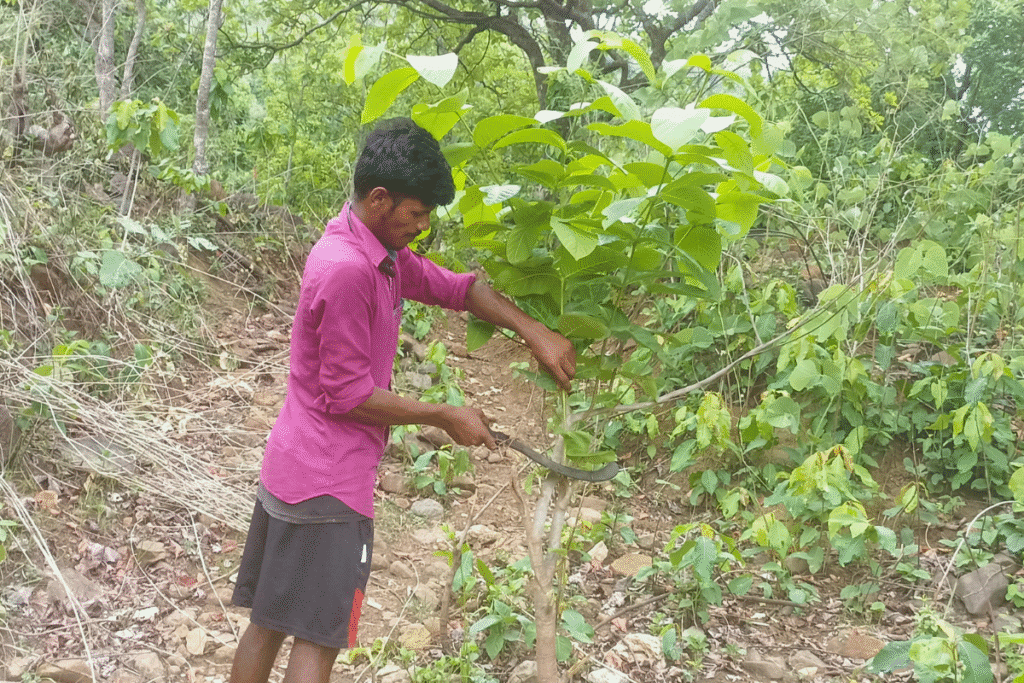
During an FMNR training session, Sundra and other participants worked together to prune the vegetation in his forest. They then tied red ribbons to the upper branches of the trees—a simple but effective visual signal that the forest was being actively managed and protected.
Over time, with proper care, Sundra’s forest became noticeably greener. The red ribbons also discouraged trespassing, helping to reduce tree cutting.
“I never knew the FMNR technique,” Sundra said. “Thanks to EFICOR for teaching this important technique of pruning and taking care of the plants and trees. The plants that I have taken care of in the forest are growing well and grew fast within a short span of time.”
Ruben Malto, from Chapri village, also participated in FMNR training. He and his wife, Chandi, have two children, Vijay and Sabina. Like Sundra, Ruben owns both cultivated land and forested areas.
On June 17, 2023, Ruben took part in a hands-on FMNR regeneration activity. He found the pruning methods—especially the careful, upward cutting techniques—both practical and transformative. After seeing the results, he made a significant change: he no longer allows anyone to cut trees on his land.
Previously, Ruben practised kuruwa (slash-and-burn) cultivation. After the training, however, he adopted FMNR methods, choosing instead to nurture existing tree systems and allow the forest to regenerate naturally.
“This FMNR has been a blessing to my family and our forest is growing again,” Ruben shared.
Across communities, small actions like pruning, protecting, and restoring trees are adding up—helping families strengthen their livelihoods, safeguard their environment, and build resilience for the future.
