
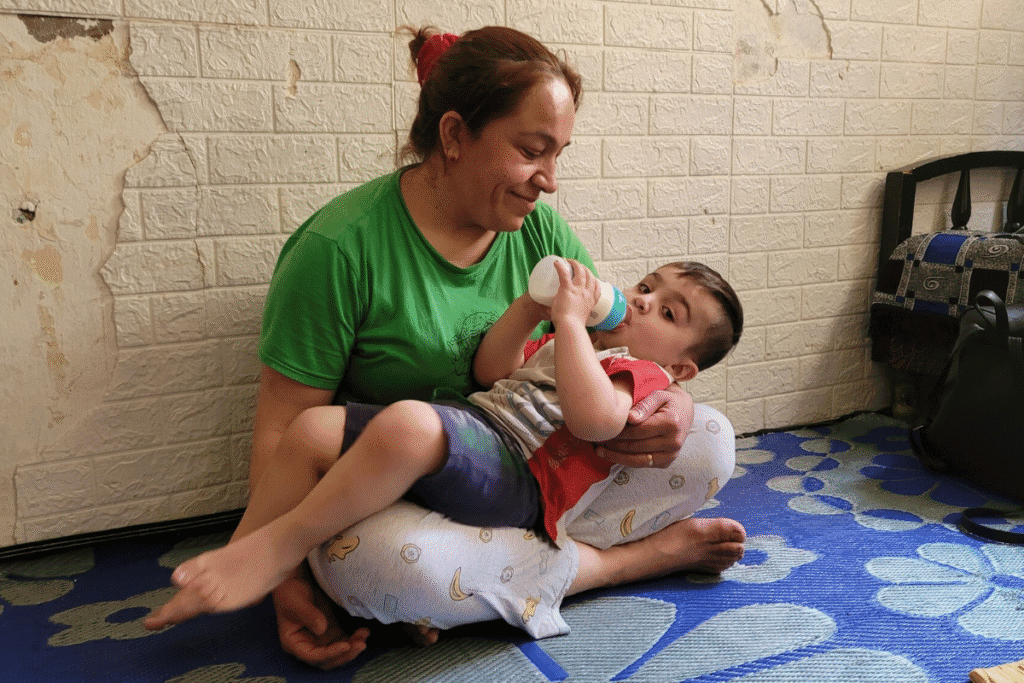
Abissa* and her husband, Kasim, live in Lebanon with their two sons, aged two and five. The couple fled their homeland to escape the hardships of a civil war that has stretched on for more than a decade.
“The war broke out and we had to leave our home. Everything got destroyed and there were no houses left in our area. We have been living in Lebanon since 2018,” Abissa shares.
Life as a Refugee in Lebanon
Life in Lebanon has been filled with challenge and uncertainty. Millions of refugees across the country struggle to meet even their most basic needs, facing extreme poverty, unstable housing, and limited access to services.
For Abissa’s family, daily life reflects those realities. “The place is very small, the ceiling leaks whenever it rains, and yet [the landlord] wants to double the price of rent,” she says.
Kasim’s disability adds another layer of difficulty. “My husband is deaf and mute. He was like that before but it got worse due to the fear and trauma of the war,” Abissa explains. “So it made it very difficult for him to find work and our financial situation has long been terrible.”
Eventually, Kasim found work in a bakery—but at a heavy cost. “[Kasim] felt very humiliated,” Abissa says. “He worked there for three years and exhausted himself for a very small salary… He never had a day off.”
She recalls how Kasim brought ingredients home each evening so she could prepare them for the next day, without pay or recognition. “When I tried to complain to the owner on his behalf, he told me I should thank God that he was allowing [Kasim] to work there.”
When Illness and Hope Collide
With such limited income, the family struggled to afford medical care. “Kasim went through a lot of health issues and suffered terrible back pain but he couldn’t get any treatment or medicine,” Abissa shares. She also faced serious health challenges herself.
“I developed kidney stones, and I had a complicated delivery for my second son. He had to be born by C-section but it left me with a lot of debt, and I couldn’t afford the post-surgery treatment and medication. It was so painful.”
Yet even in the midst of hardship, Abissa holds tightly to hope—especially for her children. “My main hope for the future is that my children can receive an education. I want them to have a better future,” she says.
Finding Support Through the Church
Through World Renew’s long-standing partnership with a local Christian organization in Lebanon, families like Abissa’s receive practical support such as food assistance, hygiene supplies, and seasonal essentials—alongside spiritual care and community.
Abissa recalls her first connection with the church: “I first met people from the church by attending one of their discipleship groups. I got to know the ladies in the group and later decided to join the church because I saw God’s hand in every situation I went through. Day by day, I felt Jesus was working in my life.”
Support through the church also helped Kasim begin to heal, both physically and emotionally. “The pastor visited my house and saw how tired, skinny, and isolated my husband was,” Abissa says. “He also was in a lot of physical pain.” The pastor helped him access medical care and, eventually, meaningful work.
“Ultimately, it is also the pastor who found a new job for my husband. I had been praying so long about it—it was truly an answer to prayer,” Abissa says. Kasim now works at a bakery connected to the church. “He is his own boss there and no one humiliates him. He is comfortable and at ease.”
In a context where despair is common and the future often feels uncertain, consistent care, shared meals, and words of encouragement help restore strength and dignity to families like Abissa’s.
“I have been through a lot of difficult times, but thank God for the church and the people there that stood by us,” Abissa says. “The people at church tell me not to be afraid because God is with me. And I believe that. I tell my children and my husband that despite all the trials, God will not leave us behind… the Lord will provide. Nothing is impossible for him.”
*Names have been changed to protect identity
