
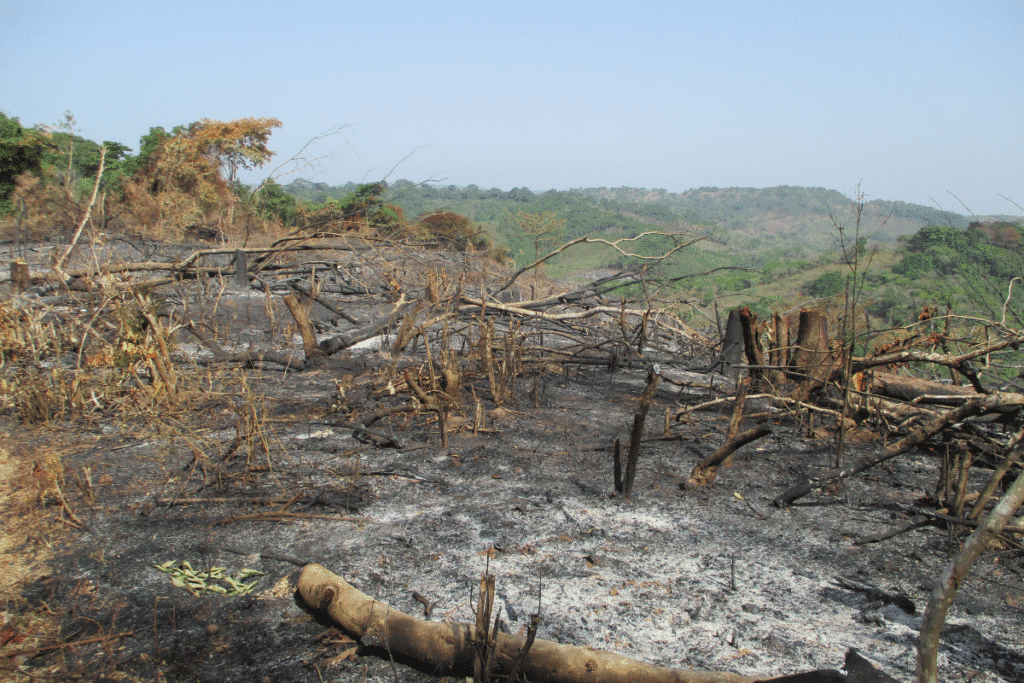
Psalm 96:12 declares, “Let the fields be jubilant, and everything in them; let all the trees of the forest sing for joy.” (NIV) Yet today, we live in a world where forests are disappearing, and the earth is paying a heavy price.
According to the World Wildlife Fund (WWF), the world’s forests have shrunk by more than 31% since human civilization began. Joseph Mutebi, World Renew’s Program Consultant in Uganda, explains that deforestation has far-reaching consequences: “There are erratic rainfalls. There are prolonged dry spells. There is depleted soil productivity. There is an increase in pests and diseases affecting crops.”
The importance of trees
Trees provide habitat for wildlife and play a vital role in soil and water conservation. They store carbon, help regulate temperature extremes, and strengthen the land’s ability to adapt to a changing climate. WWF attributes around 10% of global warming to forest loss and damage. Regardless of statistics, the increase in extreme weather is undeniable—bringing devastating impacts such as loss of life, crop destruction, and rising global hunger.
Across the world, communities are already feeling these effects. In Madagascar, prolonged drought has claimed lives and left many struggling with acute hunger. In Guatemala, families are being separated as people migrate in search of work when once-productive land becomes barren. In India, devastating floods have swept away crops, leaving entire communities facing food shortages.
Joseph notes that while policies to protect forests exist in Uganda, “the level of adherence is low.” This challenge is not unique—it reflects a broader global struggle to balance environmental protection with daily survival.
The vicious cycle of deforestation
At the heart of the issue is a difficult reality: people need to eat.
Deforestation is not simply the result of neglect or disregard—it is often driven by necessity. Many farming households face a cycle in which forests are cleared to create farmland. Without trees to protect and nourish the soil, crops become more vulnerable to extreme weather, pests, and declining fertility.
When harvests fail, families are forced to clear more land or cut trees for charcoal and construction to supplement their income. The cycle repeats, further degrading the environment and deepening food insecurity.
So how can this cycle be broken?
Joseph explains that World Renew and its local partners take a holistic approach to food security—one that addresses both environmental and economic needs. This includes intentional tree planting, especially species that provide fruit or fuel; restoring soil health through conservation agriculture; introducing savings groups; and promoting environmentally sustainable livelihoods such as beekeeping.
Above all, he emphasizes one key element: “Education. Laws are not as effective as education.”
Learning to protect the earth’s resources
When communities understand the importance of trees—and how environmental stewardship directly affects their ability to feed their families—their perspective begins to shift.
Learning about the impacts of pollution, soil degradation, and deforestation empowers people to care for their land in new ways. At the same time, gaining practical skills to generate income and improve farming practices helps restore hope for the future.
A journey from hunger to food security
Oyirwoth Dickson and Ochida Gladys, a smallholder farming couple in Uganda, are part of a food security program implemented by the Church of Uganda with support from World Renew and its partners.
Through the program, Oyirwoth learned how to organize and promote savings groups. Over time, the couple built up their savings and gradually expanded their goat herd. Eventually, they were able to purchase 15 acres of land.
Although the land was rocky and unsuitable for traditional farming, they saw its potential. Inspired by training they received, they envisioned restoring it as a thriving pasture for goats and a sanctuary for bees.
Using a method known as Farmer Managed Natural Regeneration (FMNR), they carefully nurtured existing tree stumps and protected the area from wildfires commonly used to clear land.
Today, their once-barren land has been transformed into a flourishing green space. It supports dozens of goats and 21 beehives. Ochida shares, “Sales from the honey helps me feed my family and send my children to school.”
Alongside their livestock and beekeeping efforts, the couple adopted conservation agriculture practices, allowing them to maintain soil fertility and successfully grow maize.
Motivated by their progress, Oyirwoth and Ochida are now working to inspire others. One recent step has been forming a new farming group in their community, encouraging neighbours to adopt the same sustainable practices.
Together, they are helping to build a future where fields are once again jubilant—and forests are full of trees that can sing for joy.
