
By Climate Witness Project, World Renew
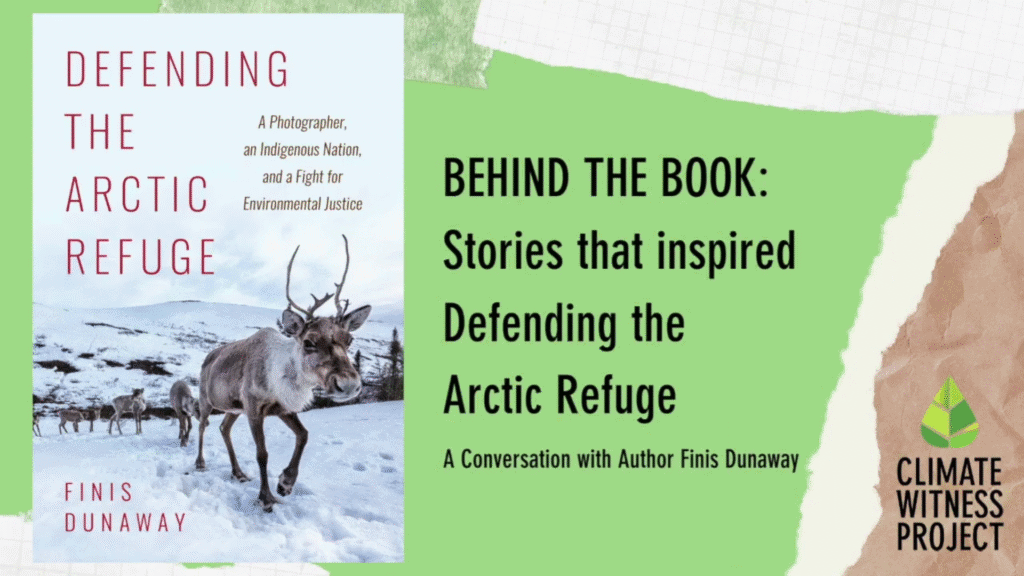
On May 20, World Renew’s Climate Witness Project hosted a book talk with Professor Finis Dunaway, historian and author of Defending the Arctic Refuge: A Photographer, an Indigenous Nation, and a Fight for Environmental Justice. The conversation examined how sustained, grassroots advocacy—led in part by photographer Lenny Kohm and the Gwich’in people—helped shape public understanding and policy around the Arctic National Wildlife Refuge.
Dunaway’s book traces the story of how a decades-long effort, grounded in storytelling and relationship-building, contributed to one of the most significant environmental protection debates in U.S. history.
Dunaway’s own interest in the Arctic Refuge began with a photograph.
“I’ll never forget that first time I saw this image. It was a poster in a library that caught my eye of the Arctic National Wildlife Refuge by Subhankar Banarjee. I did a Google search, and learned that his photos had originally been exhibited at the Smithsonian, and had fuelled a major controversy, because at this time there was an aggressive push to drill in the Arctic Refuge.”
As Dunaway investigated further, he encountered a long-running political struggle. For decades, oil companies, government leaders, and industry advocates pushed to open the Refuge to drilling, while environmental organizations and Indigenous communities resisted those efforts. At its core, the debate raised questions not only about conservation, but about sovereignty, livelihoods, and whose voices shape public decisions.
One reason the stakes were so high was the Porcupine Caribou herd. Numbering more than 200,000 animals, the herd migrates each spring to the Arctic Coastal Plain to give birth. Bears, wolves, musk oxen, and many other species also depend on the region. While the Refuge is located primarily in Alaska, its ecological and cultural significance extends beyond borders, connecting communities and ecosystems across the circumpolar North.
A Different Approach to Environmental Advocacy
While researching the Refuge, Dunaway came across articles by photographer Lenny Kohm. Kohm had recently passed away, but at his funeral Dunaway heard a refrain again and again: “If it wasn’t for Lenny, there would be drilling in the Arctic Refuge now.”
“I wondered if this was just the hyperbole at a funeral,” Dunaway said. “But the question gnawed at me: could these low-budget tours have had that much impact in a high-profile debate? Could a travelling slideshow have protected the Wildlife Refuge?”
That question became central to Dunaway’s research. Over five years, he examined Kohm’s work—particularly The Last Great Wilderness, a photo slideshow Kohm presented in communities across the United States. Dunaway came to see it as a distinctive example of grassroots civic engagement.
“…The Last Great Wilderness show was a remarkable example of citizen democracy and grassroots activism.”
Unlike many conservation efforts of the time, Kohm’s work emphasized human rights alongside environmental protection. His activism began in the 1980s, when proposed development of the Refuge intensified under the Reagan administration. While initially travelling to Alaska to sell photographs to magazines, Kohm visited two Gwich’in communities and listened to residents describe what drilling would mean for their way of life.
“He learned from them that the drilling plan represented a form of colonial violence that threatened their culture and the caribou that travelled through their land. He learned that the place where the caribou gave birth was the exact place where the fossil fuel companies planned to drill.”
Kohm came to frame the debate not solely as a conservation issue, but as a matter of cultural survival and self-determination for Indigenous peoples on both sides of the U.S.–Canada border.
From Local Storytelling to Policy Impact
After returning home, Kohm committed himself to opposing drilling through what he described as a “trickle-up theory of politics.” The idea was simple: build awareness in local communities, engage local media, and allow that pressure to move upward to national decision-makers.
According to Dunaway, this approach filled a gap left by many large environmental organizations.
“National environmental groups had rarely emphasized the human rights issues at stake, let alone actually partnering with the Indigenous groups who lived there, such as the Gwich’in.”
Kohm’s slideshow featured Indigenous voices and images showing the deep interdependence between people, land, and wildlife. Importantly, many Gwich’in leaders travelled with him, speaking directly to audiences and shaping the narrative themselves.
One woman told Dunaway that Kohm’s insistence on inclusion changed how the issue was understood.
“It was, for me, an intelligent approach to embrace how important the people were and how connected we are with the caribou. He was part of us. He listened and he engaged in a very respectful way. Lenny’s work was distinctive.”
In September 1991, the U.S. Senate voted down an energy bill that would have allowed drilling in the Arctic National Wildlife Refuge. Observers at the time credited a broad array of grassroots efforts—including Kohm’s tours—with helping to preserve the Refuge.
Dunaway later spoke with Chief Joe Linklater, a Gwich’in representative from Canada who travelled with Kohm on several presentations.
“He said, ‘If it wasn’t for him, there would be oil development in the Arctic right now.’ You think so?’ I asked. ‘I don’t think so, I know so,’ he replied. ‘Imagine if Lenny had never done that work?’”
The story behind Defending the Arctic Refuge raises enduring questions about how social change happens, whose voices are heard, and how faith, advocacy, and public policy intersect. In a global context of ongoing environmental challenges, Kohm’s approach offers a case study in how persistence, partnership, and public storytelling can influence decisions far beyond a single community.
The full book talk is available to watch on the Climate Witness Project’s YouTube channel.
Eager to Learn More?
World Renew regularly hosts conversations, learning events, and gatherings that explore faith, justice, and care for creation. Visit our Events page to see what’s coming up and discover opportunities to engage and learn alongside others.
